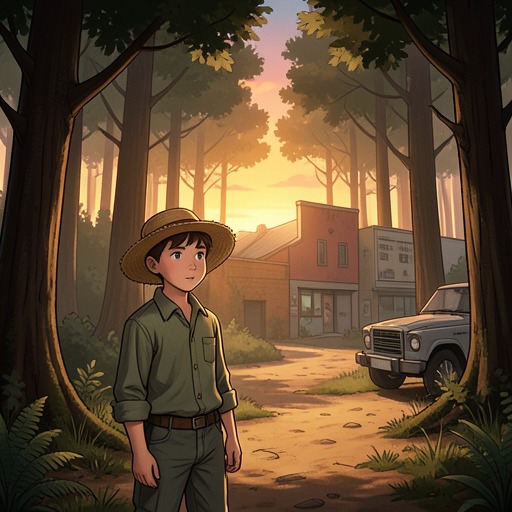
Trond Sander’s father and Jon’s mother
Out Stealing HorsesThe relationship between Trond’s father and Jon’s mother is disclosed through two sharply contrasting scenes: a moment of closeness interrupted by an accident, and, the following morning, a kiss witnessed from across the river. Trond never receives an explanation of their bond. Its significance lies partly in that silence: what he sees changes how he understands the adults around him, while the relationship remains one of the past’s unresolved facts.
An intimacy first seen at the logging site
During the summer’s timber work, Trond’s father and Jon’s father struggle together to lift another heavy log. Their labor has become dangerous: they use timber hooks rather than the safer rope method Franz had shown Trond, and the two men cannot reliably work in unison. Jon’s mother comes down on her way to the boat and the row home to Lars Haug. Instead of continuing straight to the water as she usually does, she stops to watch. Trond reads her lingering as a sign that something is about to happen, though he cannot say what.
Her attention seems fixed on something beyond the men and their work. Trond senses that she will not intervene, and wonders whether she wants the two men to continue until they settle an unnamed matter between them. Alarmed but drawn closer, he stands beside her, nearly touching her hip. Her presence affects him physically before he can make sense of it: he describes the contact as an electric shock and finds himself overwhelmed by her warmth and closeness. He puts an arm around her shoulders, a gesture he had previously made only toward his own mother. Jon’s mother does not pull away; she leans lightly against him.
The embrace is intimate but uncertain in its meaning. Trond does not know what she wants or what he wants, and allows that she may simply need the nearest shoulder. Yet the moment brings an unfamiliar wish: not to be anyone’s son. He does not want to be defined by his mother at home in Oslo, or by his father, who is working above them. For the boy, the closeness briefly suspends those family identities; for the adults, it remains unspoken.
The accident and its immediate consequence
Trond’s father and Jon’s father notice the pair. Their attention slips from the dangerous lift, and Jon’s father loses control of the timber pole. The log swings around, strikes his ankles, and rolls down the pile. Trond hears a leg break before Jon’s father falls, landing shoulder-first on the ground. The accident follows directly on the men’s distraction, though the scene does not establish that either adult intended it.
Jon’s mother tears herself away from Trond and runs to her husband. She kneels and lays his head in her lap, responding to his injury while Trond remains standing and watches. He recalls feeling a flash of bitterness toward his father, whose distraction has ended what Trond calls the most complete moment of his life up to then. Jon’s father howls in pain. His suffering also belongs to a wider family disaster: one son has died and another has left home, perhaps permanently. Trond is so absorbed in his own abrupt loss of the moment that he cannot remember whether he felt sorry for the wounded man. He senses that nothing will be as it was.
The accident thus gives the relationship an immediate, visible consequence without resolving what it means. Jon’s mother’s care for her injured husband is plain; so is the intimacy Trond has just experienced with her. The boy is left between those realities, startled by his own desire and resentful that the scene has been broken, while the adults return to their separate roles.
The kiss across the river
The next morning, after leaving the farm, Trond walks to a jetty on the eastern side of the river. Through the reeds he can see the farm where Jon lives, or may have lived. Three boats are tied there: Jon’s usual blue boat, the red boat Trond has seen Jon’s mother use, and a green boat that has ended up on the wrong bank. On a bench nearby, Trond sees his father sitting close to Jon’s mother. His father is freshly shaven; she wears the blue dress with yellow flowers that she wears when going to Innbygda, and has his jacket over her shoulders. His arm is around her.
This time there is no uncertainty about physical intimacy: his father kisses her. Trond sees that she is crying, but understands that the kiss itself is not the cause. He briefly tries to imagine a less intimate explanation, that his father is comforting a woman whose child has died and whose husband has been taken to hospital. The river is not wide enough to sustain that comforting distance in his mind. He concludes that he has seen correctly: they kiss as if it were the last thing they would do in life.
Trond cannot make himself look away, even as he tries to think of his own mother. She seems to dissolve from his thoughts, unable to fit what he is witnessing. Eventually he leaves the jetty quietly, concealed by the reeds. When he looks back, his father and Jon’s mother have stood up and are walking hand in hand toward the farmhouse. The movement from the earlier, ambiguous embrace to this unmistakable public tenderness makes the relationship harder for him to dismiss as an isolated gesture. Still, the scene supplies no account of how long they have been close, what they have promised one another, or what will follow.
What remains unresolved in memory
The older Trond recounts the scenes from a life marked by loss, including the deaths of his wife and sister in the same month and his resulting withdrawal from conversation. He remembers his father’s closeness with Jon’s mother not as a settled explanation of the past, but as part of a history he can revisit vividly without making all its parts cohere. In old age, he can deliberately enter memory and feel again the ride through the forest with his father; recollection offers access to experience, not necessarily answers about it.
The question of his father’s life remains entangled with Trond’s later relationship with Lars Haug. When Lars visits, he does not mention Trond’s father. Trond wonders whether Lars is sparing him, or whether neither man can bring their thoughts about the past into focus. He admits that he has lacked the courage to ask whether Lars took a place that should have been his, or lived years that Trond should have lived. Those questions do not prove that the relationship with Jon’s mother caused his father’s later absence or explain what became of their intimacy. They show how the remembered scenes sit beside a larger uncertainty about the father’s choices and the life Trond himself might have had.
The relationship is therefore important both for what it reveals and for what it withholds. Trond witnesses a tenderness that crosses the river and briefly draws him into its orbit, but he cannot name the adults’ history or determine its consequences. The worksite accident fixes the moment in bodily harm; the next morning’s handclasp confirms that the intimacy was not merely a boy’s misreading. Beyond that, the memory remains open, sustained by gestures, distance, and the questions the grown Trond still cannot ask.